The Cotswold Food Year: Hill House

Showing posts with label Hill House. Show all posts

Corporate team building cookery event - cook your own dinner party!

Wednesday, February 01, 2012
Go team!
Team photo. Eyes left! Someone else was taking their photo next to me on an  iphone - I  tried  the iphone, phew - technology!
 Last night's team building cookery event at  Hill House. "If only we worked together this well back at work" said one. They were cooking their 3 course evening meal from scratch in 2 hours. Everyone seemed to have a great time - it's amazing what you can do in such a short time when you work as a team!
Grilling prawns
We split the group into 3 teams - one team each taking a course each. Starters and desserts being prepared in the main kitchen and the main course in the second kitchen at the back of the house. We had made them a recipe booklet with all the recipes they needed and some plating up tips, so 'all' they had to do was come up with a plan of action and make all the components of their course come together at the right time. Gill and I were on hand to give them guidance and show them techniques, but they were in control.
Making carrot ribbons on the mandolin - no cuts. Note the glass of wine on the table there - cookery events are great!
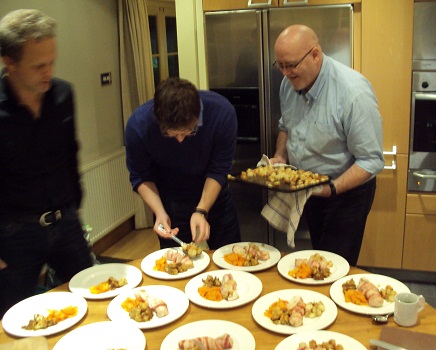
 With all the preparation ready, it was time for the teams to check the football score quickly before sitting down for dinner. Each of the 3 teams were in charge of bringing their course together so were back in the kitchen to plate it up.
Finishing touches on the starter
Starter
 Trio of fish starters
Crab salad with pink grapefruit, salmon ballottine wrapped in smoked trout and grilled tiger prawns with fennel and apple salad
Prawns are the last thing to go on the starter. "Service!"  "Oh  that's us!"
Main course
 Free range chicken wrapped in pancetta
Garlic roast potato parisienne
Roast carrot ribbons with cumin seeds
Ras-el-hanout roasted cauliflower
The turn of the main course team. "So what do you want me to do?" I ask them "Gill's here too - what  do you want her to do?" There's not much time because the food has to go out hot and they have to decide where everything goes on the plate without it looking overcrowded. They bring it off pretty slickly.
The dessert team - glazing the lemon tart - everyone's favourite job!

Last thing to go on the plate is the orange sorbet - the first thing the dessert team had made  at the start of the evening. It just froze in the nick of time. Special touch on the tirimisu - a nip of amaretto on the top. 
Dessert
Trio of desserts
Glazed lemon tart
Shotglass of amaretto & coffee tirimisu
Homemade orange sorbet


0

Kale with pomegranate and toasted cashews

Monday, January 17, 2011
"Whooooosh!" That was the sound of New Year's eve and new years day flying by.

Bit of deja vu - saw NY eve in on the M50 - same place, same time as 2 years before (the year before had been the M40 overlooking the fireworks in High Wycombe on the way back from Highgate, London). Then it was back to the kitchen to clear up the carnage from the 101 cvs we had served and get ready for the last 3 parties of the Christmas season - NY day lunch and 2 dinners in the evening. Oh and an hour's rest.

With all this going on photos were the last priority. I did manage to grab this though (documentary evidence rather than flashy pic) - at lightening speed as we served up New Yrs evening at Hill House. So tasty. It was another thing I had found on Boxing day adapted from this recipe (no yogurt but with grated nutmeg). Pomegranate molasses are now a storecupboard essential (also used with sprouts on Christmas day). At this party we served the kale with seabass and fillet of beef and the other party had it with lamb shank stargazy pie and coq au vin.
Roasting the kale you get lovely crispy bits - that's where the flavour is!
0

Pickled mushrooms

Wednesday, September 23, 2009
Mixed with a few chopped herbs and ready to go on the parma ham salad last Saturday night at Hill House.

How they were made - see comments section.

Related posts
3

Warm fillet of salmon gravadlax with rosti potato, cucumber noodles, beetroot and a dill mustard dressing

Monday, March 30, 2009
So much wonderful food in the last week, but all I have to show for it is this one dish. So busy with 87 people over 5 parties in 2 days there wasn't much time for photos. So no photo of the pigeon salad ("the pigeons are in the courtyard, they just need feathering and gutting.....") with celariac puree, black pudding, parsnip crisps and mustard vinaigrette, no photo of the pheasant au vin with pearl barley risotto, or the canapes (savoury and dessert), or the rack of lamb dish finished, or the white chocolate and blueberry cheesecake which I rather like. What we have here though is the salmon gravadlax for another new dish.
I've always loved warm smoked salmon - thinly sliced and warmed slightly under the grill it makes a great starter with a beurre blanc and a little salad. When I was looking at new menu ideas around new year I thought of using gravadlax instead.

Gravadlax was always a Saturday night job at Claridges - late after all the banquets had been sent. You had to hide the whole salmon fillets deep inside your fridge so the fish section wouldn't use them during their service, and then do it on Saturday night in case they came in early on Sunday to hunt them out. It takes a minimum of 2 days, preferably 3 to marinade, so if you had to wait till Monday you ran the risk of running out of time.


These were done on Thursday morning for Sunday night. Having done this so many times I never use quantities, but you start with orange and lemon zest and equal amounts of sugar and salt. If you have any caster sugar left from making candied orange or lemon zest this is ideal to use because it has extra flavour. To this you add a few juniper berries pounded in the pestle & mortar (or broken with the back of a knife), milled black pepper and chopped dill. Sprinkle this over the salmon and press it on. If you are slicing it thin, like smoked salmon you use skin on salmon which makes it easy to carve. Make a little nick in the skin so the marinade flavours go through the skin. Here I am using 150g fillets to serve it as a main course. You can also add vodka, cognac or gin which give you an extra flavour. Also beetroot to make the russian style gravadlax.

After this I put another tray on top, wrap it well so it doesn't get exposed to the air which would dry it out, then it is pressed (if you haven't any heavy weights you can use a saucepan full of water) at the bottom of the fridge - that way any juice that drips out doesn't go over anything else in the fridge. The pressing along with the salt helps remove some of the water content in the salmon which cures it.

2 or 3 days later you remove the marinade layer of salt, sugar, zest etc and sprinkle them with a small amount of fresh chopped dill to just coat the top, and you can bake them in the oven. Because it is cured you don't have to cook them all the way through.

Gill took these ones away to Hill House to cook for a hen party, while I was cooking pigeons, pheasants and lemon tart for a stag party at Park Hall near Kidderminster so I will get a photo of the finished dish this coming weekend when I re-create it at The Boathouse near Stratford-on-avon - watch this space.

Edit - Photo added above, taken rather hurriedly as Delia was rushing to take it to the table while it was hot - only right really.

Related posts:
2

Garlic bread

Monday, February 09, 2009
As I was making this garlic bread I was listening to the Radio 4 one o'clock news. They had sent a reporter to Shipston on Stour because it was one of the worst affected towns in the country from the recent snowfalls - the whole area brought to a virtual standstill, and most of the shops closed.


Where was I heading to deliver that evening's bistro meal? Shipston on Stour of course - where Hill House is located.

It takes more than a 'little' snow to put me off though. After the 2007 floods, I say nothing is impossible. The one good thing was though, all the local schools had closed, and generally lots of other businesses were closed as their staff stayed at home unable to get in, so the roads were empty, apart from the snow drifts.


For garlic bread recipe see here.
I used the 2nd method, and without the parmesan, as some guests did not eat cheese.


To crisp the top though cook for 10 minutes in the oven, then open the foil top and cook for a further 5 minutes.

The garlic bread, along with the salad, was a special request to accompany the lasgane made with minced beef from Home Farm.


Related posts:

Soda bread
Other dishes we have served at Hill House

Bistro menu
2

Parma ham with rocket, parmesan, caper berries and balsamic dressing

Less is more when you have a collection of the best ingredients. It makes a nice light bistro starter.

Served at Hill House near Shiptson on Stour last Saturday as part of a bistro meal.


Related posts:

Other dishes we have serve at Hill House before
Balsamic syrup


Bistro menu: http://www.bensonofbroadway.co.uk/autumn_and_winter_bistro_menu.html
0

Tartlet of Gorsehill Abbey Farm St. Agnes cheese and caramelised red onion with garden salad and grain mustard dressing

As served at Hill House near Shipston on Stour last Saturday as part of the bistro menu we cooked and served.

The St. Agnes cheese I use is organic and comes from Gorsehill Abbey Farm in Broadway. It resembles feta, but with a much more subtle and refined taste. Although you can buy this cheese if you turn up at the farm, you can also find it in a range of local shops or mail order.


For the caramelised red onions - these are cooked for about an hour and a half - see an earlier post here and finished with balsamic syrup.


Chopped fresh thyme is sprinkled on top - as seen below.


Related posts:

0

Soda bread - buttermilk vs. water & vinegar

Sunday, February 08, 2009
Surely bread making can't be this easy?


Wheat or gluten intolerance/ allergy? no problem, you can use Doves Farm gluten free bread flour. Yeast free? No problem, you can bake soda bread. There's a first time for everything after all.

Our normal bread rolls, shown on the left - half pesto (nearest the bottom), half walnut, raisin and rosemary (top)use yeast. As the yeast comes to life it emits carbon dioxide, hence bread rises.


With soda bread, it needs an acid to react with the bicarbonate of soda to cause the rising effect. Most often this acid is buttermilk, but if you are intolerant to this too, or you just can't find buttermilk on the day you need it you can - as I found out here - use water and vinegar - the vinegar giving you the requisite acid. But which is better? Only one way to find out.


It's been bookmarked for anyone else who wants to try it on the virtual recipe drawer that is Bookmarked Recipes - your one-stop shop for tried and tested recipes from the food blogger community updated every Monday.

There's only one place to find an irish traditional recipe: Darina Allen's Ballymaloe Cookery Course. Every year all the chefs at Claridges are given a cookery book at Christmas from a bursary. This was mine one year, and it's only over the last year or so that I have really delved in.

XXXXXXXXXXXXXXXXX

Edit 10/8/2012

What can you substitute for buttermilk?

Buttermilk can be hard to find in some place, or it's easy to forget when you're out shopping. You can make this really simple subsitute - see more here: 1001 Kitchen Tips #69 - What can you substitute for buttermilk in soda bread?

XXXXXXXXXXXXXXXXX

Version 1 - Flour, soda, water, salt

EDIT 22/9/2013 - Rather than the recipe above I used this one yesterday and today - much better! Replaced milk with water as it was gluten and dairy free.

For this version I used the ingredients from here and the method from the above book.

4 cups flour
1 tbsp sugar
1 tsp bicarbonate soda
1/2 tsp salt
1 1/2 cups water
2tsp cider vinegar [I used white wine vinegar]


Sieve the dry ingredients. Make a well in the centre. Pour in all of the water & vinegar. Using one hand...... stir in a full circular movement from the centre to the outside of the bowl in ever-increasing circles. The dough should be softish, not too wet & sticky.

When it all comes together turn out onto a well-floured surface. Wash and dry your hands.


Tidy it up and flip over gently. Pat the dough into a round about 4cm (1 1/2 in) deep.
Cut a deep cross on the loaf.....
..... and prick in the four corners. Bake in the (pre-heated) oven for 15 minutes at 250 oC, then turn down to 200 oC for 30 minutes until cooked. If you are in any doubt [as to whether it's cooked], tap the bottom of the bread: when it is cooked it will sound hollow. Cool on a wire rack.
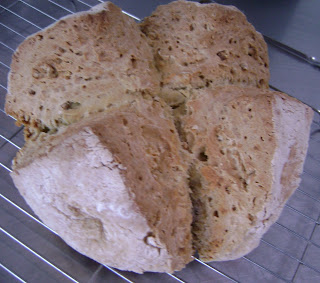
Note: Soda breads are best eaten on the day they are made, but are still good for another day or two.
My note: If you do keep it, you need to put it in a plastic bag. This keeps it from drying out to a crisp - especially the water version.
Variations - Many. Herbs, cumin, seeds. If you start adding ingredients like sultanas, raisins, eggs, whisky, orange zest, blueberries, shortening (butter or lard) etc. you go into the realms of Spotted dog, railway bread and soda bread becomes like brioche and cake - where do you start?

Also here I used just white flour. It would be interesting to use some of the different Shipton Mill flours.


Version 2 - Flour, soda, buttermilk, salt

Soda bread is a simple recipe of 4 ingredients. Less is more. It's just a matter of the right quantities - below, which come from the original Ballymalloe recipe. This is the version I made 18 hours ago 'this' morning.
450 g / 1 lb Plain white flour (preferably unbleached)
1 level tsp salt
1 level tsp bicarbonate of soda (bread soda)
About 400ml (14 fl oz) buttermilk

Use the same method as above. The buttermilk was actually a bit too much so I added a little more flour to make it less sticky.
The verdict?

Well for me - definitely the buttermilk version. Silky soft, but with a slightly crunchy crust. And so delicious. And what could be easier - with soda bread there's no kneading and no proving!

Why is soda bread linked to Ireland

A little research suggests the link to Ireland (you always hear of irish soda bread) comes from the fact that wheat traditionally grown in ireland is soft wheat due to the climate, rather than the hard wheat used to produce strong bread flour which rises easily with yeast. The soft irish wheat is more suited to bread soda (bicarbonate of soda) as a rising agent.

What type of flour do I use for soda bread?

There's a word of warning here that I found when asking this very question. It doesn't seem right using anything but strong bread flour to make bread, but in fact, the strong flour has a high gluten content which is best for yeast breads, but absolutely not soda breads. So use plain flour. You can also make a gluten free soda bread with rice flour - but that's another day.


These 2 loaves were served at Hill House as part of a bistro meal - The first version on Friday and the buttermilk version on Saturday.

Related posts:


5

Assiette of desserts

Sunday, November 23, 2008


Glazed lemon tartlets
Strawberry and champagne tartlets
Mini strawberry meringue roulade
Shotglass of tiramasu
Mini creme brulée (Japanese spoon)

As served at Hill House last night

Related posts:

What does 'assiette' mean? Assiette of desserts 12 July 2008
Murder mystery weekend, assiette of desserts, 7 June 2008
Assiette of desserts 27 September 2008

3

Smoked Donnington Trout Trio

Ballottine, smoked trout fillet with lime and smoked trout tartare
Salmon and smoked trout roulade (ballottine)

Fresh salmon..... ....is rolled, as described for my canapé roulades.....

Then poached in water at 80⁰C, off the heat. As the roulades are so small the residual heat in the water cooks them in about 8 - 10 minutes. This way the salmon stays soft - if you kept the water on the heat they boil and become hard and overcooked.
When cooled the roulades can be unwrapped and rolled in smoked trout.
These ballotines are then left to rest in the fridge, so they stay together when you cut them. I garnish them on top (as shown above) with a little crème fraîche and caviar.

Fillets
For this I ask the trout farm at Donnington for whole (unsliced) sides of smoked trout. I then cut thick d-cut fillets and cut these into 2 or 3 depending on size (i.e. how far up from the tail you are). These are sprinkled with grated lime zest (which I also do for barbecued fresh trout) and milled black pepper.

As guests are tucking into their homemade bread rolls which we always serve as they sit down, I pop the trout fillets into the oven for just 2 - 3 minutes, so they are warm, the last thing to go on the plate before the waitress takes them away. If you warm the fillets through, the texture changes - it softens like the ballottine. You can leave them in to cook fully if you prefer, but they are best served like this at the last minute, just warmed through.

The fillets sit on thinly sliced cucumber, and the richness of the smoked trout is off-set with the crème fraîche, lemon and chive dressing
0