The Cotswold Food Year: venice

Showing posts with label venice. Show all posts

2014 A to Z Blogging Challenge - I is for Italian veal rolls (involtini) with stuffed aubergine: Chef in Venice #11

Thursday, April 10, 2014
There's nothing better than getting away from cooking 24/7 and going on holiday..... and cooking! 
Involtini of veal
My excuse is it's more relaxed cooking - and food shops and markets in other countries are always so much more exciting!
We're going back to 2011 now - seems a long time since my last holiday....
Been to Venice a few times - the Biennale keeps dragging me & my friend back - I've been told I'm going next year (yay!).

Cooking for yourselves rather than eating out in Venice (along with a few other canny tips) means you can get by on a shoestring - I'm only a poor chef after all.
I also try out new things. Right then I was trying out roasted whole aubergines. We served them at a few weddings afterwards - a great vegetarian alternative for hog roasts I find.

Roasted aubergine

1. Cut aubergine in half lengthways.
2. Slash the aubergine flesh with a sharp knife in centimetre wide cuts so you almost get down to the skin, but not quite. Then turn it 90 degrees and cut the other way so you end up with diamond shaped cuts.
3. Cut garlic cloves in half and place these in random places in the cut aubergine. Do the same with rosemary and oregano sprigs.
4. Drizzle olive oil over generously, season with salt and pepper and roast in the oven @ 180 oC for about 20 mins.
5. Once cooked you can either leave to cool and scoop out the flesh and use for aubergine caviar or you can chop the flesh and mix it with.. say... parmesan, oregano, salami, tomato and cooked onion and place it back in the aubergine shell and re-bake it to let all those flavours melt together. Tasty!
Involtini veal raw with mozzarella, roast peppers & capers
With the involtini of veal you can either roll it in pancetta like I did with this one or secure it with cocktail ticks like the one above. You can be all healthy and bake it in the oven or fry it in butter with lemon juice added in at the end.
A trip the the Veneto hills is definitely recommended! (It really is that blue!)

Random figurine with parasol on the backstret walk early morning. Get to know the back streets & shortcuts - saves fighting your way through the grockles! 
Besides the 2 main exhibition centres of the Biennale (Giardini & Arsenale) other countries have their pavillions scattered in random palazzos, churches and tumble down buildings across the city - and it is these which by far provide the best experience... maybe because you have a break in between finding each one, or that actually finding some of them is a mission in itself!

For the 2011 Anish Kapoor offering you had to travel by vaporetto as Basilica di San Giorgio sits on its own island. Less is more they say. It is a work he has done apparently in other venues, but this was the first time in a sacred place - and the symbolism sure got everyone thinking....


Related posts 

Other Chef in Venice posts
0

Chef in Venice #10 - Grilled asparagus with smoked cheese wrapped in parma ham & sun dried tomatoes

Wednesday, June 26, 2013

This has to be the best view from the door of a supermarket surely?
With all the news from the 2013 Venice biennale it's giving me a craving to get back there. So much so that I am trawling photos at 4 in the morning  - I have 3 years worth and counting at the moment of unblogged food photos - there's only so many hours in the day......

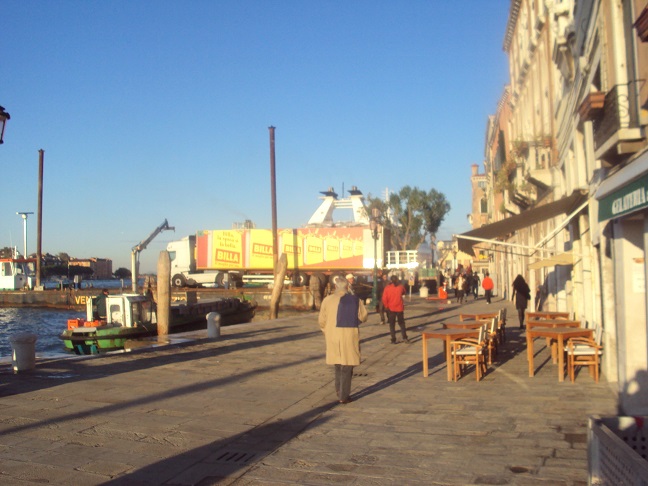
Deliveries at the Billa store on the Zattere can still arrive by lorry - as long as the lorry arrives by barge. So wonderfully inefficient. 
The secret to Venice - get out there before the grockles arrive.
This happens a lot. Even when you think you know.
Morning shopping route takes you past the lady with  the parasol, or is it an umbrella, or  a 1960's hair dryer? Quirky is good.
Picked up this smoked cheese......
....wrapped it in parma ham...
.....and sage from the roof garden...
.....and served after a 'hard day' traversing the biennale with asparagus and sun  dried tomato. Where did the wooden salad server come from? I blame the prosecco......

0

Chef in Venice #9 - Baked figs with gorgonzola and honey

Wednesday, November 30, 2011
Simple things are often the best!

After a full day walking round various biennale mind = blown. Time to chill out in the garden. This garden (below) happens to be in the beautiful Palazzo Zenobio who were hosting I think 4 country's pavilions. Another quirky contempory opera video from Iceland - great. Out in the garden though we found a pommegranate growing (see it middle right?) - food is never far away........

They were waiting to close the doors behind us in the end - you have to make the most of these things. On the way back we picked up some figs - it would be rude not to after all......

Related Posts
2

Chef in Venice #8 - Roast guineau fowl with sauteed apples, gremolata and a honey and lemon dressing

Tuesday, November 08, 2011
Just what you need after a day pounding the Venetian streets in search of the more obscure Biennale exhibits dotted around various houses, palazzos & churches. If truth be known these are often the most exciting. Found a great youtube vid below of someone who seems to have done a 4 day tour of the Biennale - great holiday memories.
Cooked on a potato trivet - the secret being all the roasting juices are absorbed by the potatoes, while at the same time the bird isn't sticking to the roasting tray. Keep the potatoes and re-use them another day, or serve them with it - so flavoursome.

I went for the light touch with this - no heavy red wine sauces/ gravies need apply. Instead, a gremolata (lemon zest, grated garlic, chopped rocket) sprinkled over the top and honey, lemon, mustard, prosecco, olive oil warm dressing bathing it. Light and refreshing! Underneath sauteed raddichio treviso (keep it local) and soft polenta. Thinking it could be adapted for a wedding dish some time in the future.

2

Chef in Venice #7 - Poached eggs with parma ham on toasted ciabatta

Tuesday, October 25, 2011
"We should write a 'survival guide to Venice on a budget'" said my friend last week.

Chiesa St. Barnaba..... at 8am (early start that day)

Chapter one would certainly be titled 'Cook for yourself'. Self catering should mean just that - it's hard to get out from a restaurant under €100 for 2 - and believe me, everyone you meet will like to tell you so, and that's before they start on the price of drinks. But go to the local Billa supermarket and markets in campo St. Margherita (not the Rialto - that's where tourists go) and that €100 goes a long way!

This was breakfast one day - poached eggs with parma ham on toasted ciabatta. When you're traversing the Ventian streets in search of Biennale exhibits you need a decent start
The eggs were supposed to be for making pasta - hence the vivid orange yolks. Didn't stretch to making pasta - it was a holiday after all - but they were rather good like this!

Don't forget the coffee though - it starts every Italian's day. It also has to get a mention in surviving Venice on a budget - make a macchiato at your place and it's going to be around 10 cents vs €2 - €3 (most often around the €3 mark) when you are out and about. Might be wonderful coffee (actually nobody makes it like the Italians, but still, when you're just a poor chef.......

Related Posts

2

Chef in Venice # 6 - Sole meuniere

Sunday, November 23, 2008
It just wouldn't seem right leaving Venice without having eaten sole. There are indeed so many fish dishes you can make, but sometimes, if you have quality ingredients less is best.

If you have a grill pan, or contact grill/ indoor barbecue like the one shown previously, you can grill them, using my flour tip. Or you can cook them meunière style.

The fishmongers will often fillet them for you, but cooking whole on the bone will give you a much softer, moister favour. Although you can remove the skin, I like to leave it on - the skin of the sole, like chicken, is the tastiest part.

This is how to cook your sole:


1 - Firstly you need to scale them. Use the tip of a filleting knife and go against the grain of the scales.
If you leave the scales on, these can stick to the pan, so when you try and turn them the skin rips.

2 - Take the roe out. This can be done leaving the head on (some people like to eat the heads too). Make a slit by the gills and you can pull out the roe.
.... or you can cut the head off and remove the roe, dropping the fish head into your fish stock.
3 - Then wash and dry them and coat them in seasoned flour or polenta. As described earlier this stops them sticking to the pan.

4 - Add a little oil to you pan first, and then butter. The oil increases the temperature at which the butter will burn - as sole take a good 15 - 20 minutes to cook the butter may burn before they are cooked. Medium heat is best for this - too high and they will be cooked on the outside while being raw in the middle. Aways cook the presentation (white) side first, so that side cooks in a clean pan.

5 - An easy way to tell when your sole is ready to turn is that it is opaque (i.e. cooked) from the base to the middle bone. A minute or two before turning, I add a little more butter, so they brown well. Turn with a roasting fork skewered through top end (spatualas can damage/ break up the fish, which you don't want to do with the presentation side).
[sole finishing cooking once turned]

6 - You know when your sole is cooked when it starts to split slightly at the top:
7 - You can then use a spatula to take it out on to a clean board for filletting. This is the difference to some local restaurants who serve them whole, leaving you with a plate of bones at the end, another reason why I prefer cooking my own (another being you can choose a much larger sole on the market than a restaurant will serve).

8 - Sauce meunière - Strain the remaing pan juices in to a small pan. You should have a beurre noisette by now. When hot add lemon juice and chopped parsley. It is now ready.

9 - Filletting you sole - I clamp the knife down on the side bones and ease them away, taking care to keep the skin in one piece. Then run the knife latterally through middle, on top of the bone. You can then remove the top two fillets (in one piece) using the knife as a palette knife, and put them to one side.
Then remove the bones in one piece - add them to your fish stock pot. Slide the top two fillets back on top, and you have a finished sole as shown at the top, there served on top of crushed potato and sautéed pak choi. Spoon your meunière butter over the sole.

For more dishes from Venice see here: http://www.thecotswoldfoodyear.com/search/label/venice

0

Chef in Venice #5 - Grilled langoustines with aubergine caviar and rocket salad

Wednesday, November 19, 2008
“You go” says my holiday companion (in all fairness she does organise the whole holiday) “while I get changed….”
What? On my own? In a food market? You should have seen the dust move.

Food markets for chefs are like the row of chic jewellery, clothes, textiles and glass shops that run from the Rialto to San Marco’s are to the rest of the world. You need it.
You’ll know about the Rialto of course. Even if you haven’t been to Venice. It is the market, the meeting place - and that’s back in the times of the Merchant of Venice. But as you become a more experienced itinerant (as Venetians call visiting tourists) you start to learn the secrets. And one of them is the market stalls in the Campo Margherita.

Venice is really just a serious of very small islands all joined together by bridges. Each of these small ‘islands’ has its own campo (square) and church. The Campo Margherita is one of these secrets. The new glass bridge in Venice, much ridiculed for it’s over-spend and delays, has sealed the fate of many traders in that it takes visitors directly from the Piazzale Roma (the main entrance point, and the end of the road literally - for any road vehicle at least, to Venice) over the bridge and on through Cannaregio passed the Rialto to Piazzale San Marco. If you there just for the day (perish the thought) you might never cross onto the San Palo/ Dorsoduro side.
This is why, walking through the Campo Margherita, you see mainly locals. At the weekends you see the Italian locals too. And when you see the locals you know you’re on to something good. Like the Rialto the fish stalls (there were 3 of them there) start early - while the rest of the city is waking up, and by lunch time they’re packing up. But unlike the Rialto, the prices are much more reasonable. On Saturday and Sunday you see a real market place - antiques, clothes, fabrics, Murano glass - everything you see elsewhere in the city - again, everything but the inflated tourist prices. Yes - the Campo Margherrita is really the place. And while you’re considering your purchases you might just rest in one of the many tavernas for a cappuchino. There’s so many things you can do with langoustines. But sometimes they are such good quality you want to just enjoy them as they are - less, as they say, is more.
I went down the simple route. Turn them oven and cut them straight through the middle.

Then place on a baking tray. Drizzle generously with olive oil and season with salt and pepper and place under the grill till cooked. And I served them with aubergine caviar as shown in the last entry and rocket (dressed with olive oil and lemon juice).

What else could you do with my langoustines?

  • You could also grill them on a flat grill, or griddle - the taste that the cooking shells impart - there can be no better taste.
  • You could also sprinkle over chilli and garlic as they cooked, or chilli oil.
    You could also serve them raw as sashimi (not advisable for children, the elderly or pregnant ladies).
  • You can also drop them in court bouillon for a minute so they cook that way, leave the body on but peel the tail, so you pick them up by the head and dip the tail in flavoured mayonnaise.
Notes

Always buy your langoustines live. As soon as they die the flesh deteriorates. Like lobsters the flesh goes to a mush. They may be cheaper in a supermarket, but it’s worth finding out a real fishmonger who sells them live.

It’s hard to find a good high street fishmonger these days in the UK - the old business model just doesn’t work with the reality of supermarket shopping. Many fishmongers have moved from the high street to obscure sites on industrial estates from where they serve the catering trade. Many of these are also open to the public - such as Simpsons in Stratford opn Avon and New Wave in Cirencester which I have been to - though I see now that New Wave have opened a shop in Cirencester (which I will have to investigate) - that is a good step forward.
It’s worth looking these up in the yellow pages, and you can phone them an order to pick up, or if you‘re on their delivery route they may well deliver.
0

Chef in Venice #4 - Aubergine caviar

Tuesday, November 18, 2008
Cut your aubergine (I used the local variety) in half, then score down to the skin (taking care not to actually cut through - you don’t want to dice it).


Drizzle generously with olive oil (aubergines really soak it up) and season with salt, pepper, and any spice if you want to - cumin is nice. As we had rosemary in abundance I studded it with these, pushing them down in to the flesh, so as they cooked it would impart the flavour. You can also use whole garlic cloves. These roasted for around 45 minutes or so at 180 oC.
Once cooked you can take a dessert spoon, and run it along the skin to scoop up the roasted flesh. Then chop it, mix with crème fraich/ or marscapone/ yogurt (depending on what you have), olive oil, lemon juice and season. Ideally you add chopped fresh coriander too.

What else to do with aubergine puree

  • If you want a strong roasted flavour leave them uncovered - if you want a lighter taste and colour cover the tray of aubergines in foil while they are cooking.

  • You could puree the cooked aubergine in a food proccessor and add the resulting puree to you red wine sauce.

  • It makes a great vegetarian sandwich topping.
  • Instead of roasting like this you can put it directly on the gas flame of your stove. Keep turning every 5 minutes or so. By the time it is cooked in the middle it will be well charred on the outside. This gives the resulting puree the most wonderful smoky flavour.


For more Venice dishes see here - http://www.thecotswoldfoodyear.com/search/label/venice
1

Chef in Venice #3 - Veal escalope with risotto Milanese, roasted raddichio Treviso and beurre noisette

Ideally when you do this you need a stainless steel frying pan and flour or polenta. Unfortunately on this occasion, as I was on holiday, I had neither.

Using a stainless steel pan and my salt tip is the best solution - non-stick pans just can not get hot enough. To get the heat you need to get a good seal, the non-stick pan it will smoke, burn and will be ruined beyond repair for the next time you want to use it.

The risotto Milanese was made in the traditional manner with softened onion, rice, saffron, white wine (prosecco substituted), then marscapone and the finest parmesan reggiano (how I love the Billa shop) and herbs (I used fresh chopped marjoram) to finish.

This was the first time I had tried using the raddicho Treviso. In the UK you normally use the round raddichio (chioggia). If you buy a ready prepared salad mix it will undoubtedly have raddichio in it, for both colour and flavour. Treviso - a large industrial town - is just a few kilometres from Venice and it‘s where many people who work in Venice actually live. I had seen the Treviso variety in the market many times before but had always passed over it. What we had been missing out on! Like Belgium endive, raddicho is also really nice cooked. I pan fried it on a high heat to colour the outside, then finished it off on a baking tray in the oven - though you could just keep it in the pan to cook, but as I only had one pan I needed it for the veal.

To cook the veal let the butter melt in the frying pan till it sizzles. You could now coat it in flour or polenta. Add your veal to the pan and fry on both sides for about a minute (this is, after all, the veal equivalent to the beef minute steak). For the ebst flavour you want a good caramelised colour - which I couldn't achieve here with the non-stick pan. Then remove the veal to a plate to rest leaving the butter and juices in the pan. The butter should be nut brown in colour by now - if not, you can let it cook a little longer - but too long and it will burn. Add strained lemon juice (I used ½ a lemon) and chopped parsley (although as we had chives growing on the altana I used those).


For more Venice dishes see here - http://www.thecotswoldfoodyear.com/search/label/venice
2

Chef in Venice #2 - Roasted quail with pumpkin puree

The Venice Film Festival, The Carnivale, The Biennale - there's something for every time of the year in Venice. We've been going to the Biennale each time since we first discovered it in 2003.
Strictly speaking it's not a biennale any longer - as the year in between, such as this year, the festival focuses on architecture, exploring the symbiosis between art and architecture, the challenges architects face in the world economy - and the direction in which that guides them (the need for housing to accomodate the growing world population for example), and, of course, their ideas and visions for the future.

The exhibitions ouside the 2 main areas (the Giardini and Arsenale) held in odd palazzos, churches and pavillions are, in our opinion, even better - half of the fun to be had in actually finding where they are in the first place. And after a day trekking around town there's nothing you want to do more than get down to some serious cooking......

Quail was on the menu.
Because they are so small a whole one will do as a starter, but it is quite easy to eat two whole ones for a main course, particularly after so much walking and fresh air.
After drizzling with olive oil and seasoning with salt and pepper I roasted them for around ½ an hour. Quail, like all other meats is best cooked on the bone to conserve both flavour and moistness.
After a couple of minutes resting out the oven I could put the chopped squash in salted water to cook, then take the quail breasts and legs off the bone.
These went back on the tray to rest and the quail carcasses went in a pan with water and on the boil to make a quail stock while we opened the prosecco.
Once the stock had reduced to a ladlefull, I passed it through a sieve, added a glassful of prosecco instead of the usual white wine) and let that reduce a bit, added a bit of butter and balsamic, then dropped in some cooked oyster mushrooms from the day before - it was holiday after all…..

Then time to finish it off. Place the tray of quail in the oven to heat up. Drain the squash, mash it, season it up, then add a dash of olive oil and bit of rosemary from the altana.

For more Venice dishes see here - http://www.thecotswoldfoodyear.com/search/label/venice

0

Chef in Venice #1 - Veal kidney with oyster mushrooms

I left the Adagio from Mahler's fifth on the CD rack at home - this, after all, was the chef in Venice rather than Death in Venice.
The Billa on the Zattere in Venice has to have the best view from the front of a suprarket of any shop in the world - looking out over the Guidecca canal to the Island of the same name. It also has the most amazing array of quality ingredients - but that’s probably only because I am used to English supermarkets. The charcuterie and cheese counter makes you almost believe you are back in the food halls of Harrods or Selfridges, which, living in the Cotswolds as I do now, are but a distant memory. And the variety on the pasta, polenta and rice shelves make you want to move there permenantly.

On the fresh meats counter we stocked up on the essentials - veal escallops, veal kidney and whole quail - not exactly what you find in the local supermarket back at home.
It had been a while since I had cooked veal kidneys - lambs or pigs (which, having a stronger flavour is preferable I think to lamb, and more economical) being the more usual choice.
The preparation is the same. You just need to cut them through the middle laterally, then snip out the main veins which you can do with scissors - especially with veal kidney as they are so large.

I then fried them in olive oil (when you’re in Italy it’s the only thing to use) about 5 minutes either side till just cooked in the middle (if cooking for high risk groups I.e. children or pregnant women ensure they are cooked through) then rested. Meanwhile, without my normal stock of ingredients I have back in my own kitchen, I made a sauce from sautéing the oyster mushrooms, then deglazing the pan with red wine - and when this was reduced adding a little butter. Just before serving I added a little chopped rocket - using it as a herb.

Roasted squash and gnocchi finished off the dish.
0