The Cotswold Food Year: potatoes

Showing posts with label potatoes. Show all posts

Papas Arrugadas

Friday, February 15, 2019
Papas Arrugadas or Canary Potatoes as we also know them. Cooked in so much salt they have a salty crust on them. Originally they would have used sea water, but these days you use tap water with tons of salt.
The pic here on my ipod doesn't quite do them justice - they were really crusted all over with salt. 
My grandparents found Tenerife back in the early 80's. Back then you played cards in the library, dressed up for dinner and repaired to the drawing for brandy or liqueurs. Going back twice a year (November and the whole of February) they met up with a social scene of fellow English holidaymakers of the same age who kept going back to - a home from home.

Every night it would be a different restaurant - there were lots to choose from, many of which now have sadly closed as the younger generations tastes have moved on, and the owners of the restaurants have retired. Most of the restaurateurs knew their regular customers, even though they came out only twice a year - that's how to keep people coming back!

One of the must have accompaniments for every main course was the papas arrugadas served with mojo sauce which comes as either green or red, based on green or red chilli peppers. We've always tried to reprocate the sauce, but never quite got it as nice. A work in progress. Green seems to go better with fish, red with meat.

Up to last year I had also never quite ventured into trying those potatoes, but they were the ideal accompaniment for whatever Spanish theme menu I was doing that night.
Image result for canary potatoes

You say Papas, I say Patatas

The Spanish word for potatoes is Patatas as you know from patatas bravas. Papas is the word they use in Latin America. It was the Incas who brought potatoes over from Latin America in the 1500's, at first as a plant, nobody really wanted to eat them.
In truth we don't have quite the right potatoes in this country. In Tenerife it's Papa Negra. The nearest I could find was Jersey Royals because of the hard earthy skin.

This is more salt than you can think is humanly possible, but hang in there- they're going to be amazing potatoes!


Ingredients

750g Jersey Royal Potatoes (if out of season small King Edwards might work well)
150g Sea salt
Water to cover

How to

Put the Potatoes in a large saucepan and cover with water. Add the salt. Bring to the boil and boil for about 20 minutes till soft. Drain the water and put the potatoes back in the pan on a low heat to boil dry. This is what makes the dry salt crust on the outside.

If you're cooking these in advance I found you could reheat them in the oven on a tray with foil over for about 15 minutes @ 180 oC.
0

Potato Roses Recipe

Beware making something nice for a wedding tasting - you might have to reprocate it on the wedding day itself!
And so it proved with these potato roses.

Your wedding is your special day. There's no second take, so you have to try everything possible to make it the best you can. I certainly tried to push out all the stops for the weddings we catered for and often made things nobody else would do because they're just too time consuming and which increase the pressure in the kitchen on the day. But I always loved the challenge. 
We were making these late in to the night prior to the wedding day, kind of wishing I'd never had the idea. Then they chill overnight and you can reheat them through the oven just before serving. 
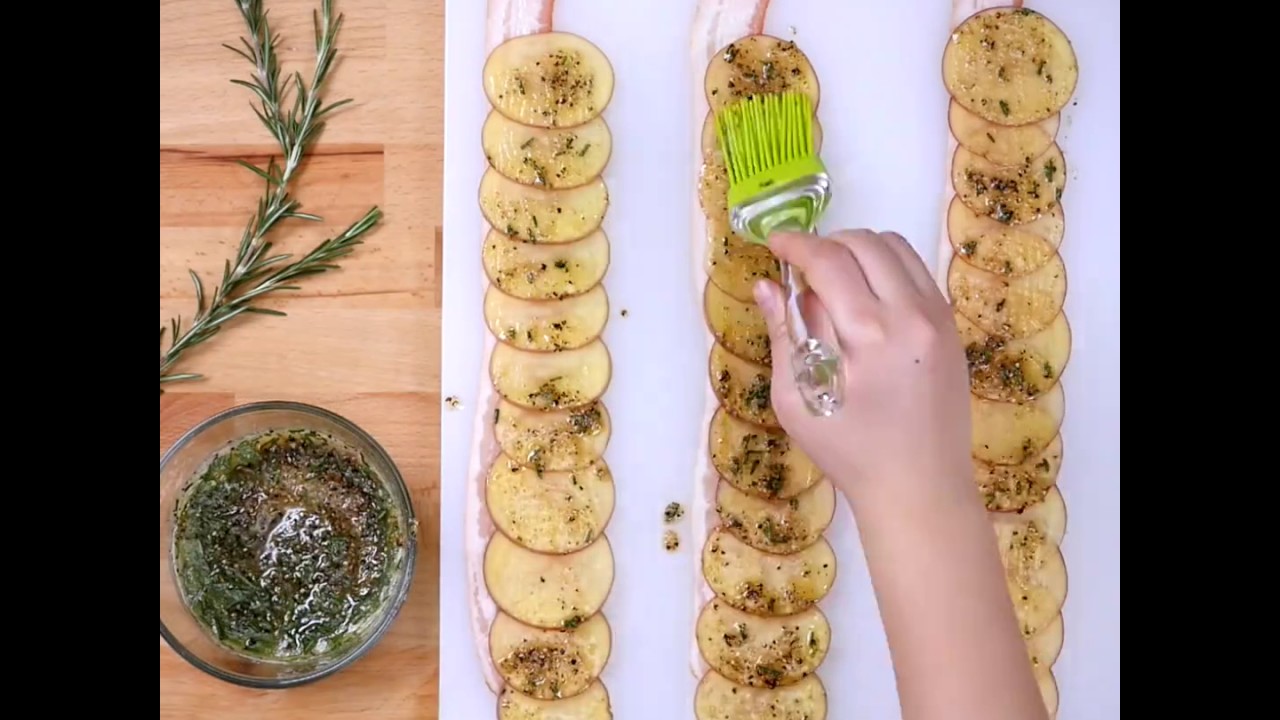
You need to start with Maris Piper potatoes - they are fail safe crispy on the outside and soft in the middle. There's a great video here which shows how they're done. That recipe uses bacon as well - what a great idea!  

Ingredients
8 large Maris Piper Potatoes - look for a more oven tubular shape, peeled
100g Butter, melted (might need slightly more - depending on how you go)
Fresh thyme, taken off the stalk as individual leaves
Fresh garlic, chopped
Salt and freshly ground pepper. You could try using smoked salt.
Image result for potato roses
How to lay out potatoes
Tip
It's a good idea to make sure the potatoes are at room temperature. I kept mine in the fridge to keep them fresh, or outside in the winter, so when I was making these potato roses I left the potatoes out in the kitchen to come up to temperature.
If the potatoes are too cold when you mix the melted butter through, the butter solidifies before you have time to lay them out. 
However, if the butter does set you can nuke them in the microwave for a minute or so just to melt the butter again and you're good to go.

Method
  1. Before starting, lightly butter a muffin tin. 
  2. Slice the potatoes thinly on the mandolin. Discard the end pieces (you can bake these separately as crisp snacks with some olive oil & salt). You just want nice big potato slices. 
  3. Place the potatoes in a mixing bowl with the melted butter, garlic and thyme. Season with salt and pepper. Mix together very well, trying to separate out each slice of potato. 
  4. Lay out the potato slices on your kitchen work surface as above. Start with one slice, then overlap with another and so on in a line. I found 16 - 20 slices made a decent portion. 1 line makes one portion. 
  5. When you have laid them all out, roll them tight like a cigar from the bottom to the top. Then place in the muffin tin as seen above and unfurl slightly into a rose shape. They spread out more as they cook - as you see below. 
  6. To bake I found the best way was at 160 oC for about 45 minutes, then turn the oven temperature up to 180 oC for further 10 - 15 minutes to crisp them up. Test them with a knife - the centre should be soft like chips. If they are not cooked in the middle but golden on the edges cover in tin foil to stop them browning and allow them to carry on cooking.  
  7. Lift out of the muffin case with a mini palette knife. 
  8. If you are cooking these in advance, halt them at the 45 minute point where they are still just soft in the middle, but not fully crisped up, like the ones at the top of this page. At this point you can cool them, cover them and refrigerate them till you want to use. They should last 3 days in the fridge. 
  9. Then, when you want to finish them off, place in a preheated oven at 180 oC for 10 - 15 minutes till hot, crisp and golden.

0

Homemade frugal crisps

Wednesday, February 03, 2010
A good kitchen they say has no waste.....
..... even when it comes to potato peelings. There's only so much my compost bin will take after all.

A lot of the fibre and vitamins are in or under the skin of potatoes. Adam made these last November (that's how far behind I am with blogposts).

Rolled in a little olive oil, maldon salt and smoked paprika (watch out though - the one we had was like rocket fuel!) and baked in the oven till crisp, turning a few times so they cook evenly.

Better than deep frying. Why are they are pushed to the side of the tray? Heat trasfer - in a gas oven it cooks from the outside in, so pushing them to the side (like the roast potatoes) ensures they will cook evenly. If you have a convection oven there's no prob.

So what do you do with your potato peelings?
1

Saffron potatoes

Wednesday, June 17, 2009
A little saffron added to the turned new potatoes as they boil results in a wonderful flavour. The colour is good too.

These went with the scallop dish last Saturday.


Related posts:

Scallops with saffron potatoes and pea puree
New potatoes with chives
0

Crushed Jersey Royal potatoes

Sunday, April 19, 2009
Is there anything you look forward to more than the first Jersey Royals of the season?
They have a taste like no other. Here they are boiled and lightly crushed with the all important skin left on, and mixed with a little unsalted butter and chives.

Best eaten outside they can just make a meal in themselves. These accompanied fillet of beef and also sole in white wine sauce. Also great with trout and smoked trout (or salmon) though.


Related posts:
2

New potatoes in chive butter

Monday, February 16, 2009
We use charlotte potatoes. Turning a potato is one of the very first things you learn as a chef - if you're lucky. The days of large establishments - hotels and even catering companies having a team of chefs turning vegetables is gone, as they can be brought in ready done. I still prefer making my own as shown above - there's no shortcut to quality.

Normally we mix a little melted butter through, but these were left without, so guests could add vinaigrette instead - which goes nicely with the grilled chicken and roast vegetables they had requested.
1

Irish stew and dumplings

Monday, January 05, 2009

Irish stew, 29 December 2008, before adding sauce on top

Although we have many dishes to tempt on our bistro menu, we do occasionally get asked for special requests, such as this one between Christmas and New Year for Irish stew and dumplings.

Made in almost the same way as my lamb and apricot. I used lamb neck rings from Home Farm. A I arrived to pick it up they were in the middle of cutting lamb dice in their butchery so Iwas able to take a few discarded lamb bones too which added even more flavour.

The lamb was seared like the beef for the beef pie, then cooked with onions, celery and canelled carrots for 3 - 4 hours in lamb stock. The advantage of cooking it on the bone is that the bones impart all their flavour to the meat, and the sauce while cooking, and on the whole, just like cooking duck or chicken on the bone, it is just much more succulent.

After that you drain the sauce and leave the lamb to cool. You can add the potatoes and dumplings in 30 minutes before the end of cooking, or, as I did, cook them afterwards so they are cooked perfectly. While the lamb meat was cooling, the sauce was split in half and returned to the boil with potatoes - one pan containing diced estima potatoes, and one pan with turned new potatoes. Once cooked these could be chilled.

The same sauce was then used to cook the suet dumplings.

When the lamb is cool enough to handle you can take the meat away from the bone, sinew and fat. These bones can then be re-boiled to make an additional stock which can be reduced and added to the finished stew.

When cooled the meat is cut into bite-size morsels, and the sauce adjusted to taste.

If you are eating straight away drop the lamb, carrots, onions, potatoes, dumplings and maybe a little chopped rosemary back in to re-heat, or if not, leave to cool in the fridge and re-heat the next day (always tastes better heated up, when the flavours have had time to develop ovenight).


Related posts:

Lamb and apricot casserole
1

Fondant potatoes

Monday, September 24, 2007
How to make Fondant potatoes

"How do you make those amazing potatoes?" everyone keeps asking, "What's the recipe?" so this is how I make them (call it a recipe if you will):

How to cut fondant potatoes
Peeled or not peeled? If you're doing these at home, and you have relatively small potatoes you could leave the skin on. For cosmetic appearances, I cut them with a cutter as shown below. There is a link on the left sidebar to a great set of cutters ideal for fondant potatoes!
If you leave the skin on the potatoes while you cut you can make chunky oven bake chips with the trimmings as shown below. If you peel them before cutting you can use the trimmings to make mashed potato, which can be used fresh or frozen for future use.

Cut the top of the potato so you have a flat surface.

Turn around and do the same with the other side.
You cut out the potatoes with a cutter. Now, carefully with a small vegetable knife, run around the sides of the cutter to release the trimmings. Now with a potato peeler go around the edges so you have a 45 degree angle edge which prevents the edges from burning. If you are cutting these in advance you can store in water in the fridge.


How do you cook fondant potatoes?

They are cooked in chicken stock, a little butter (about 80 - 100g will do 12) and thyme. You can also add garlic, lemon, bayleaves, saffron etc. You cook them in this till the liquid is reduced to half, turn them and keep cooking till the liquid is reduced to a thick syrupy glaze.

The whole of the stove is taken up with cooking 180 fondant
potatoes for a wedding in August 2008
Then you transfer them to a baking tray and spoon the glaze on top to coat them - it should be like spooning syrup on top - then bake them till they are crisp and golden, about 15 - 20 minutes at 180 oC.
Served with the fillet of beef:

Fillet of beef with oxtail, caramelised shallots and fondant potato.
See more on this dish here.

6 Hour cooked shoulder of Home Farm lamb with roasted lamb cutlet served with leek stuffed fondant potato, steamed kale, broad beans and balsamic jus
Fondant potatoes stuffed with leeks - it's like the fondant potato suprise see more here.

Leek filled fondant potatoes at a wedding
Can I make fondant potatoes in advance?

Yes - you can also make these the day before, leave them to cool and refrigrate them. To reheat pop them in the oven on a baking tray for around 15 minutes at 180 oC.

What type of potato do I use for fondant potatoes?

For flavour - I always favour desiree. A good all rounder is maris piper. Estima are great too - depending on time of year. Near the end of the season they get floury and tend to fall apart when making fondants.

Can I freeze fondant potatoes?

Yes! Best way is to prepare them as above, transfer them to the baking tray and spoon the glaze over as above, but at this point let them cool down and the glaze set on top. Freeze them at this point - with enough space between so they don't stick together. They can go straight into the oven frozen to finish cooking - c 25 - 30 minutes till golden (and of course - hot in the middle). At first as they defrost they look soggy - don't worry however - it's the science of freezing starch. Once they are up to temperature they are completely back to normal!

Using the potato off-cuts

The off-cuts from the potatoes make great chunky potato wedges - roll in olive oil and maybe a little smoked salt:. Serve with homemade tomato ketchup.
FAQ - Why are they called 'fondant' potatoes?
It's hard to find a definition. If you wiki fondant it tells you fondant is water and sugar cooked to the soft ball stage. Fondant is a base ingredient all pastry chefs have stored ready to make sweets and icing. A similar proccess is taking place when you cook fondant potatoes but with stock (aka water) and butter instead of the sugar.
When I asked the first time I ever cooked them, at Charingworth Manor, I was told fondant means 'cooked in their own juices'. When we did them there, they were cooked just in butter (lots of), garlic and herbs - it turns the humble potato into almost a confection - so we're back to the origins of 'fondant' being in the pastry kitchen again. I prefer using chicken stock as well - it gives you more flavour. And less calories of course.

Cider fondant potatoes
Instead of cooking these in chicken stock you could use cider, or a combination of the two. Beer? Well I haven't tried, but it's an idea.......

Related posts:
Rosti potato
Dauphinoise potato
Rosemary roast potatoes pronto
Boulangere potato
Mashed/ creamed potato
Sunday roast
Grilled fillet of beef with oxtail, caramelised shallots and fondant potato
5